Tag Archives: slider
17. Jun, 2013

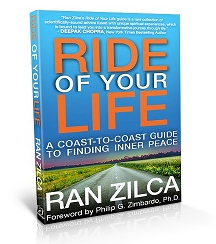
Ride Of Your Life – Book Foreword (Sneak Peek)

Ride Of Your Life – Book Foreword (Sneak Peek)

Three years ago my life was supposed to be perfect. On the professional front I was a success story: a veteran of an elite technology unit in the Israeli army, recruited by the world’s largest private research lab, then turned hi-tech startup entrepreneur. On the personal front: happily married, three great kids, and a house in the suburbs. On the surface, I was living both the American dream and all that I have personally wished for.

Life was supposed to be perfect, but it wasn’t.

Under the surface, daily life was comprised of a cautious walk between raindrops of emails, calls, meetings, and carpools. An attempt to stay dry in a torrent of enslaving, often meaningless obligations. The past accomplishments had come at the cost of invisible strings that tied me down. Decisions, big or small, were now dictated by the needs of my career and my family: work on the weekend, wake up for Sunday school, buy a house in a good school district, drive a minivan. Life was an infinite conveyer belt of tasks and constraints.

But as hard as it was to be busy, it was scarier to be free. In the rare times I could decide where to go or what to do, I had no idea what I wanted. Yes, I wanted to spend time with my kids and with my wife, but beyond my identity as a husband and father I didn’t really know who I was anymore. Underneath the layers of being a scientist, a musician, engineer, or businessman my soul was hiding from me in a silent void.

Like all stories of personal transformation, it all began with a faint nagging ache that gradually grew into a pain. The inevitable feeling that something was seriously missing and had to be retrieved. Nights of reflection turned into weeks, and weeks into months, and at some point things came to a boil. When they did, a suppressed childhood dream surfaced from the emotional chaos: I want to be a biker. I want to be on the open road, gripping chromed, raised handlebars and stretching forward leather biker boots. I want to ride from coast to coast, through the back roads, with no plans, no reservations, and no schedules. The motorcycle will be my channel to inner peace.

At that time I had not even sat on a motorcycle before, so some work had to be done. In the summer of 2009 I slowly started pursuing my goal, one tiny step at a time. I took the motorcycle safety course, fell, injured myself, and failed it. Then I went back, passed, got a tiny 250, joined a local riding club, and traded to a bigger bike. By late spring of 2010, I was ready to go all the way: ride solo from New York to California, and mark a big checkmark on my bucket list. My wife, who in the meantime had seen her husband transform from a groggy chimp into a smiling human supported the endeavor, and the project turned from a dream into a plan. I allocated a modest budget and started preparing to go on the road in the fall.

The plan was to ride alone, from New York to California, and spend all days and nights in solitary contemplation, gathering inspiration from the road and from the people I may meet along the way. It was a simple plan, but it was also a little risky: being away from my family for weeks, without an opportunity to process and discuss my thoughts could possibly be boring, perhaps even depressing. It could be great to have the opportunity to stop along the way and discuss the thoughts that emerge, and process them. Luckily for me, I actually worked with some of the most famous experts one would consult on a soul-searching journey: authors like Deepak Chopra and Stephen Covey, and prominent psychology researchers like Phil Zimbardo, James Pennebaker, and Sonja Lyubomirsky. I called them and asked if I can stop along the way to chat with them. They all agreed. Ride of Your Life turned from a personal journey into an opportunity to find some broader answers to the questions that people ask as their lives evolve. To join the wisdom of the road with the professional take of experts to form a guide to inner peace. I got some video equipment and scheduled approximate dates to meet with the experts in Maryland, North Carolina, Texas, and California.

On Sunday, September 19 2010 I headed west shocked and anxious to leave my family without knowing exactly where I’ll be spending the night. In the five weeks that followed I rode through mountains and valleys, forests and deserts, towns, cities, and oil rigs, in rain and in sunshine. 6,000 miles later I got back with answers, and had regained my inner peace.

The Ride changed the lens through which I see the world, and affected my life in a profound way: prior to leaving I met in New York with the founders of a company called bLife. When I reached Los Angeles I met with them again, ended up selling my company and became bLife’s Chief Scientist.  I also went on to study life-coaching and now coach and teach life-coaching courses. Two years later, I decided to move with my family to Israel, and since then I divide my time between the West Coast, the East Coast, and the Middle East.  I found not just inner peace, but dare I say – enlightenment. Today I’m a better husband, better dad, better professional, and just a better human all around, and I experience daily life in a very different way.

This book accompanies my coast-to-coast journey. It describes the meditative experience of riding daily for hours, and the insights that slowly emerged from riding experience and the professional angles of the experts I interviewed. It is also a book about dreams. Sometimes a small change in perspective demolishes the barriers, turns life around, and makes dreams come true. Today my mission as a scientist, coach, and author, is to help people make that shift and accomplish their dreams.  This is what the book is really about.

I hope this guide helps you go on the ride of your own life. Ride safe and ride on!

Pre-Order Ride of Your Life – the book!

Share
02. May, 2013

Letting Tweetie Go

Letting Tweetie Go

In September, When my son turned ten, he asked for a bird; a yellow Cockatiel that he saw in a local pet shop. The bird had cute orange circles on her cheeks, and whistled happily at each person walking by her cage. My son had fallen in love with her. Each time we went by the store he asked to walk in and would gaze at the little parrot, mesmerized and fascinated. We didn’t really want another pet in the house, but there was no choice. We had to get Tweetie before someone else did. On a sunny Monday morning we all went to the pet shop, and returned home with Tweeite standing proud in a beautiful golden cage. My son’s joy was limitless. We placed the cage in the living room and gave the bird a warm welcome to her new home.

In the weeks that followed, we discovered Tweeite’s unique character. She learned to identify the members of the family, and assigned a different whistle to call each one of us. When a car would pull in the driveway, Tweetie would whistle relentlessly in excitement, greeting the visitor before they had a chance to knock on the door. She used another special whistle when someone left the living room and a different one when someone entered it, a whistle to let us know she is hungry, and a whistle to ask the dog to keep off. Her whistles became the soundtrack of our home.

Tweetie’s wing feathers were trimmed, so she couldn’t fly. When you’d put your finger in front of her she would stand on it, and let you carry her around. We did not like the sight of her trimmed wings, but we liked having her safe and close to us.

One morning, a few weeks after she moved in, we cleaned Tweetie’s cage and left the back door open. We did not realize that in the meantime her feathers grew a little and she was now able to fly a short distance. After sneaking out in tiny steps, the she opened her wings wide, and flew to the roof. My wife and I started calling her, and the kids, who heard the screams, got out of the house and joined the rally. Tweetie must have gotten startled by the yelling. she  flew away and disappeared in the park behind our yard. I eventually found her on one of the low branches of a park tree. All I had to do is hold up my hand, and she climbed onto my finger. I went back to the house as the triumphant dad and the bird’s savior.Tweetie

From that day on, we made sure that all the doors and windows are shut when Tweeite was out of the cage. We decided not to trim her wings. The weeks went by, and her feathers grew. It became harder to get her back in the cage. She loved to fly around the house, and when I would put up my hand for her to climb onto my finger, she would let out a cry, avoid it, and fly away. She could not longer be be fooled by the old finger trick. Tweetie wanted to be free and loved practicing her flight moves, enjoying her newly-grown feathers.

Then yesterday afternoon, the back door was accidentally left crack-open, and tweetie slowly walked out. Everyone froze and started whispering orders at each other: “don’t move”, “walk slowly this way”, “I will try to catch her, you stand behind me…”. Just then, our dog saw her walking out and jumped on her. She immediately flew up to escape the attack. First she flew to the neighbor’s roof, then she flew in circles around the house, listening to us scream and beg her to come back, then finally, surprised by the strength of her muscles and her fully-grown feathers, she flew up into the sky and vanished. For a few moments we could still hear her famous whistles fading, and then she was gone.

We left Tweetie’s cage open on the patio table along with some water and food. We hope for her return, but we know she’s not coming back. The children are sad, but they are happy for Tweetie, and understand her choice to leave them and be free. Taking care of the Tweetie was a great experience, but we now realize tat she was never ours to own. We all miss her, and wonder: If we end up getting another bird – would we do the same thing and let its wings grow?

Share
10. Dec, 2012

The Happy Airplane

The Happy Airplane

After spending a great week in Santa Monica I flew back today on a connecting flight through Philadelphia. I was a little late to leave my hotel, but the cab driver assured me with a big smile that I will get to the airport on time. He took a special shortcut and stepped on it as if his life depended on it. Sure enough, we got there early. And with the same big smile he helped me get my stuff out of the trunk and wished me a safe journey.

Inside the terminal, the lady at the check-in desk greets me with a fake frown: why am I paying for an extra bag? “Next time”, she tells me, “bring a big carry-on. Your bags are light. You can save some money.” I tell her about the presents I bought for my kids. We laugh and joke about it. She gets me a good seat and sends me off with a smile as big as Texas.

I get on the plane, and it’s the “happy plane”. People are smiling at each other, joking. It feels like a school trip. The couple sitting next to me are Arlene and John, retired educators from Philadelphia. Ten minutes after take-off Arlene and I are engaged in flowing conversation. I learn about her kids, her marriage, her lifestyle, her family. Her brother recently of passed away after battling cancer. Her daughter travels around the world. She recently became a vegetarian, but John, her husband, is a meat lover. He and I talk about Jerusalem, the wailing wall, and its history. Probably the first time someone discovers I’m from Israel and talks about something other than the conflict in the Middle East. The spirits are high and the vibes a good. Almost in an unnatural way.

I get up to get some coffee, and a guy in the exit row literally pulls me over by the sleeve. He has three empty tiny bottles of Jack Daniels on his tray, and a white pair of earbuds in his ears. He asks me about the AC/DC T-shirt I’m wearing. I tell him about the concert I went to. We hug (?!!) and he hands me his earbuds and says “you gotta listen to this”. I put one in my ear and hear Neil Young going full steam. He commands “both ears!” I put both earbuds in and listen to Neil go as my friend plays air guitar in his seat. We talk for a few more minutes about music all wired up with teenage excitement. And then I remember the original reason I got up from my seat. I go get that coffee.

I continue down the aisle, and I’m completely baffled. W h a t – i s – h a p p e n n i n g?? Did someone slip something in my drink? Is this some kind of twisted dream? I look back at The aisle. People are standing and talking with each other, smiling and occasionally joking with each other. This is not normal, I think to myself.

When I get to the end of the aisle I see John. He pulls me closer so I can hear him better through the noise of the engines at the back of the plane. He says “you have very special smile. When you walked in the plane I immediately noticed it. You have a happy soul”.

And then I get it. Yes, this is possibly an airplane that’s happier than average, but that’s not really what’s going on. It’s me – I’m the Happy plane. I woke up in a good mood this morning after spending a great week of work in LA, and I’m happy about seeing my wife and my kids tonight. I’m smiling, and the world is smiling back. Big time. The Buddha said “I am not in the world – the world is in me”. And it’s true. The world lives in our minds. We create it. And when you create a world of happiness inside of you, the world outside of you catches on it, and universes of happiness are born in the people around you. Any plane can be the happy plane, if you smile.

Share
11. Aug, 2012

America’s Midlife Crisis

America’s Midlife Crisis

This past fall I embarked on “Ride Of Your Life” – a 6000 mile solo motorcycle trip from New York to California, and a personal journey to inner peace. I rode through the thin veins of the map, the back roads that pump America’s life-blood from coast to coast, off the interstates. On My journey, I met with behavioral scientists, researchers and thought-leaders, and spoke with hundreds of people in motels, diners, parking lots, and gas stations.  Each of them provided me with a new perspective and fresh food for thought. Every day, I would ride for five or six hours and let the quiet wisdom of the road melt it all in. I went on the road for a midlife trip across the country and discovered an empathetic country going through midlife issues itself.

America’s days as a passionate young adult are over. In the past 60 years it has grown from a kicking adolescent to a mature and respectable grown-up. Now, at its prime, it is suddenly feeling malaise. Things are no longer what they used to seem. It all used to be simple and now it is complicated. There are too much obligations and not enough fun. America today, is uncomfortable. Think about 9/11, the wars in Afghanistan and then Iraq, the chain of recessions followed by the global financial crisis. Think about the frequent and extreme shifts of the presidential and midterm elections. Think about your health and how much it costs you, and think about the way you spend your money today. It all adds up to being very uncomfortable.

But this may be a good thing.

Behavioral sciences experts agree that being comfortable for too long corrodes one’s natural ambition, desire, and zest. In contrary, the restlessness of midlife is what fuels the renaissance of a person as a mensch [1], and the reintroduction of zest into life. Our lack of comfort could be an indication that we are on the verge of a great positive change. Just like people who go through a midlife crisis, we can emerge from this transition evolved and better if we take some action instead of ruminating on the glory days of our country’s youth.

On my ride’s third day I met with Caroline Miller, a leading positive-psychology coach and best-selling author. Caroline uses research on the human quality of zest to get her clients unstuck and out of a state of a “reactive rut”. When working with clients going through a midlife transition she tries go reawaken their enthusiasm. According to Carolyn, zest is found in abundance in children but wares off over the years. It is defined as “keen enjoyment”, the ability to just go for stuff with a leap of faith and soak up every good thing about the experience without hesitation. America has lost its zest and the ability to take a leap of faith and fly men to the moon. I believe this is our time to take the biggest risks and embark on inspiring, big projects. Morale is not a luxury. People need to feel inspired by their country to be motivated to go out and do stuff themselves. We should start working on the expedition to Mars, pronto.

Phil Zimbardo is one of the main figures who have shaped the science and practice of psychology over the past five decades. I met with him in San Francisco, after crossing the entire country. Phil says that more than often people feel lonely in midlife. Midlife is the time when people lose contact with their college and high-school friends and need to form new relationships. We too, are losing our childhood allies and need to build new relationships. The guys who looked like our sheer enemies when we were younger may become our new friends. Take Egypt is for example. The Arab world is split between forces pulling it back to the violent dark days of religious war and forces pushing towards the bright future of peace, education, and trade. Egypt is the leader of this moderate stream. A country that in the 60s was clearly considered a major axis of evil.

Sonja Lyubomirsky, a leading positive psychologist and the author of the book The How Of Happiness, says that midlife is also the time when people start having deep regrets and think about their “lost possible selves” [2] – the missed opportunities that are not likely to return. I met with Sonja a day before returning home to my family. After five weeks on the road I felt at peace with myself and could easily resonate with what she said. The healthy thing to do is at this age is to accept that some past opportunities are gone and to let them go. The high-school crush is long married, that job offer from20 years ago is now long gone. We need to do that too. As a young adult, America dreamed big and when you dream big you are bound to experience some failure. Our dream of a broad middle class has resulted in a thick layer of poverty, and our dream of spreading the values of liberty and democracy to the world has also resulted in aggression and war. Perhaps we should seek more “age-appropriate” ways to continue our pursuit of abundance for all and a liberated world.

Like anyone experiencing the perplexity of midlife, we need to accept that we have come of a certain age, let go of lost opportunities, make new friends, and revive the zest of our magical childhood as a country. All we have to do is forget about who America was and start thinking about who America will be.

Studies on human happiness show that people emerge from their midlife crises happier and that happiness peaks around the age of 60. Midlife transition is painful but leads to an improved life experience, one that is more mature, open, and fulfilling. Other countries may look at us and feel bewildered as we go through our midlife deliberations. They are either too young to understand or too old to remember. I believe that America will soon emerge from her midlife malaise settled and sound, ready for the ride of her life.

[2] The Princeton dictionary defined Mensch as “a decent responsible person with admirable characteristics”. The origin of the word is in the Yiddish language.

[1] Laura A. King, Hoshua A. Hicks, “Lost and found possible selves: Goals, development, and well-being” New Directions for Adult and Continuing Education, Volume 2007, Issue 114, pages 27–37, Summer 2007

Share
16. Jul, 2012

Count to Ten and Reclaim Your Autonomy from Your Limbic Brain

Count to Ten and Reclaim Your Autonomy from Your Limbic Brain

One of the top determinants of well-being is autonomy: the perception that one can govern oneself and not have decisions dictated externally by someone else. Understanding what autonomy is could be tricky. Many people mistake it to mean the same as independence, but it’s not. Being autonomous does not mean you do not depend on others to help accomplish tasks, reach your goals, and provide you with the many benefits of having company. Having autonomy is not about being able to do stuff all by yourself. It’s about having the power to decide what happens next in your life. Autonomy is about having the authority to make decisions, not the independence to execute on them. Even more specifically, it’s about having the *perceived* power to do so.

Carol Ryff’s groundbreaking research on the determinants of well-being places autonomy as the most important factor that affects our psychological wellness. The modern science of motivation, namely Self Determination Theory, establishes the desire to be autonomous as the most important factor in providing intrinsic motivation for the pursuit of one’s goals. In my view it is the single most important contributor to one’s well-being and inner peace.

Changes in one’s mindset and outlook can change their own perceived autonomy. Take for example this guy in the supermarket standing right in front of you in line. You are already late for dinner and sweating yourself off, while he insists on paying in cash, picking his pockets for the exact change and holding up the line for long valuable moments. He is hijacking your time, deciding what happens next for you (your spouse will surely be mad), and denying you of your rightful entitlement to be the master of your own destiny. This guy is taking your autonomy away. Or at least it seems so. If you really enumerate your options you may realize that you actually have alternatives to choose from. You can give up shopping and just head straight home, you can move to a different cash register, or you can simply pay for the guy with your credit card and put an end to his search for change. When you become aware of your alternatives your perceived level of autonomy increases, your anger quiets, and your well-being gets a nice boost.

In addition to people and situations that may attempt to deny you of your autonomy, there is another potential autonomy thief that lies within. One that accompanies you everywhere you go. And unlike the supermarket guy he is much faster than you.

Think about the moment in the grocery store when you realize that you are going do be delayed more than you had thought. It doesn’t take long for your skin to sweat and your fists to clench at that moment. You are well ticked-off before you get a chance to consciously think about the possibility of being late or make any real assessment of the situation. The reason is that the stress response initiated in your limbic parts of your brain (also known as the “lizard brain”) are much faster than the thinking and planning that happens in the more evolved parts of your brain. When you get stressed or angry it feels like someone else has pushed a button and is pulling on your strings to make you behave a certain way. This fast mechanism simply *bypasses you*. It goes straight from the limbic brain to your sweat glands and to the muscles that clench your fists. It’s controlling what happens next, denying you of your autonomy. And in doing that it adds unnecessary misery to the small misfortune of being late for dinner.

Heaps of words have been written about the “fight or flight” stress response and about how irrational and inadequate it could be to the safe modern environments in which most of us live today. The one important factor that is often overlooked is that these responses are faster than any conscious thoughts over which you have control. To nurture your well-being and reclaim your autonomy from your limbic brain you have to allow more time for the slower neural processing of conscious thoughts to kick in. And to do that you may need to utilize the oldest intervention in the toolbox of the science of psychology:

Count to ten.

Share
11. Jan, 2012

This Year Touch The Rainbow

This Year Touch The Rainbow

Last year I went on a coast-to-coast solo motorcycle trip. A project I call “Ride Of Your Life” – a journey to inner peace. I embarked on this 6,000 mile ride only a year after obtaining my motorcycle license and along the way interviewed scholars and scientists like Deepak Chopra, James Pennebaker, Sonja Lyubomirsky and Byron Katie. I also spoke with dozens of people I met on the road at gas stations, parking lots, restaurants, rest areas, and inns. When they heard that I was carrying out my longtime dream of riding coast to coast, people responded by opening up and sharing their dreams, aspirations, and regrets. A nameless biker, who lives 4000 miles away is a great confidante.

Here’s what I found.

People dream about things that are within their reach. No one I met wanted to be famous, go to the moon, or climb Mt. Everest. It’s not that people’s dreams are trivial or uninspiring. In fact, it was amazing to hear what diverse futures people dream for themselves: becoming a teacher, writing a short book, getting back in touch with a relative, seeing Japan or New York, opening a car shop, speaking a second language. These are all things that a lot of people get up every morning and do, but could seem unattainable to the people who dream about them. To get back in touch with her sister, Sally only needed to pick up the phone and call, but the fear of the response at the other end of the line kept her from doing it. To see Japan, Steve only needed to buy an airline ticket, but he was not sure that he could handle the long flight. My own experience was the same. A lot of people ride motorcycles, yet at first it seemed unattainable to get a bike and learn how to ride it.

One’s dreams can seem as high and illusive as a rainbow, but it’s all a matter of perspective.

The lens through which you see the world determines your reality. On the fifth week of my ride I met with author and spiritual leader Deepak Chopra in Carlsbad, CA. One of the things we talked about was a shift in perspective he experienced while he was ordained as a Buddhist monk in 2010. That year Chopra went to Thailand to experience living the life of a monk, disconnected from the external world for three weeks. At night he slept alone on the floor (with the exception of the company of a few mosquitoes), and in the days he went on an “alms round” carrying a begging bowl, dependant on the villagers nearby for food. Chopra was not used to walking barefoot on pebbles and rocks, and when he came back the first night his feet were sore and he was in pain. The abbot noticed this and suggested a solution: when walking, focus the attention on the foot that you lift (and the sensation of relief) instead of focusing on the foot that you put down (and the sensation of pain). The next day Chopra followed this advice and his pain was gone. “The world is open to interpretation” Chopra says “and you have full control on where you decide to put your attention”. Pain or relief is just a conscious choice of perspective.

Phil Zimbardo is one of the people who shaped the face of modern psychology as we know it. We met upon my arrival in San Francisco on the third week of my ride and talked about the power of perspective. His seminal Stanford Prison Experiment demonstrated the power of perspective to an extent that seems almost impossible. In the experiment, Stanford students were randomly divided into “prisoners” and “guards” in a makeshift prison established in the university’s basement. Within hours, the guards adopted their role and started getting rough with their fellow students who were given the role of prisoners. These in turn, adopted a mindset of helplessness, and accepted a reality where they are imprisoned and at the mercy of the guards. As a contrary example, Zimbardo describes the case of Vaclav Havel, who spent years in a real prison but viewed himself as a free person and eventually became the president of Czechoslovakia.

Looking at the world through a different lens can make pain appear and disappear, and prison walls materialize and dissolve. Could it be that your wildest dreams are in fact within reach if you only look from a different angle?

Two weeks into my cross country motorcycle ride I arrived in the Grand Canyon. The day started with rain and fog, and cleared up with sunny skies later in the day, creating an amazing display beautiful, perfect rainbows. As I was standing there gazing at the captivating site it occurred to me that something in my perspective feels warped. I was not looking up at the rainbow. In fact, I was looking down. The multiple rainbows above the Grand Canyon were underneath me, shining above the Canyon’s mile-deep chasm. Sometimes you don’t even have to jump to touch the rainbow.

At the dawn of the new year many of us take the time to examine our lives and crate a design for the year to come. This year resolve to touch the rainbow. You don’t necessarily have to aim high. Change your perspective and you may discover that the rainbow is right at your eye level, waiting to be touched.

PS: The photo of the sign asking not to touch the rainbow is real, but not meant to discourage anyone from dreaming big. It was stationed at the New York Hall of Science in Queens, next to a “rainbow machine” comprised of electric lights and motors.
Share
04. Sep, 2011

Is the Financial Crisis Bringing Us Together?

Is the Financial Crisis Bringing Us Together?

While running errands this morning, I stopped at a local bank to meet with the branch’s investment manager. The sun was shining bright in the sky, and since I had no work meetings scheduled I allowed myself to dress (very) casually. I walked into his office wearing short pants and a t-shirt and couldn’t help feeling a little self-conscious. The banker was at least twenty years older than I am, mummified in a suit and tie, and really looked like, well…, an investment banker. He welcomed me in a serious face and suggested that we spend a little time discussing my finances. “This may be useful”, I thought to myself, “but it’s not going to be fun”.

Then, something unexpected happened. The conversation about my “numbers” quickly turned into a broader conversation about the economy, and how both of our families are dealing with it. In less than ten minutes we were leaning back in our chairs, ignoring the computer and the paperwork, and talking like old friends who met in a pub. While talking we also realized that we are both bikers and the banker shared some great riding roads up north that he knows, curving around lakes and forests (who knew bankers ride motorcycles?). We also discovered that we share a military background. He served in the Army during the Vietnam War, and we talked about how we both value our military experience as a milestone in shaping our values and thoughts. At some point we even talked about the guilt that people in the service feel when they survive combat. I don’t really remember how we got there… Finally, after thirty minutes of great conversation (which probably would have been much longer had banks provided beer) I left and went on with my day.

Getting into my car, I thought about this unusual positive experience. This guy seems really cool, and we may end up riding together on weekends. But if it weren’t for our shared financial concerns we would have never really talked to each other. The barrier of age, professional context, and dress code, would have simply been too high. The past few years have been bad for some and worse for others. Homes and jobs were lost, families fell apart, and once-buzzing Main Streets are now scarred with vacant stores. And while no one would choose to face the adversity of a stumbling economy, the psychological value of coming together is tremendous. Let’s hope that we manage to maintain this sense of togetherness when things finally bounce back. And let’s hope that happens real soon.

Share
02. Aug, 2011

Happiness, Technology, and the Joy of Positive Computing

Happiness, Technology, and the Joy of Positive Computing

I recently gave a talk at the Leading to Well-Being conference at George Mason University. The event included a great mixture of speakers, including Dr. Barbara Fredrickson who spoke about the emerging science of love (!). The topic of my talk was “Positive Computing” – new technologies that use research in psychology to drive and foster no less than human flourishing. We started developing Positive Computing software at Signal Patterns and now continuing in full force with bLife Inc.

When the science of happiness is used to create new technology some fascinating things happen. In fact, the Ride Of Your Life started back in 2009 when I was using the Live Happy iPhone app. The app has a section where one can enter goals they are contemplating, and assess how likely these goals are to bring them lasting happiness. I entered different goals, one of which was going cross country on a motorcycle, just for the fun if it. At that time I did not yet have a motorcycle license and had no riding experience. In the months that followed the iPhone app took me through small baby steps, one thing led to another, and a year later I found myself on my second bike, riding from coast to coast.

During the conference a video crew was walking around and interviewing the speakers. We talked about happiness, and how geek-developed technology could possibly change the world.

Here it is:

Share
31. May, 2011

Do You Have To Break Your Back To Be Happy?

Do You Have To Break Your Back To Be Happy?

A few weeks ago a nagging pain at the side of my left leg appeared out of nowhere. At first, it was muffled and intermittent, then gradually turned sharper and more prominent, until eventually it was impossible to bear. It was time to see the doctor. My primary physician, who knows me for many years, listened to me for less than 20 seconds before interrupting me with a textbook diagnosis: “L3 herniated disk in your spine, impinging on the Sciatic nerve. It’s very common. You need some physical therapy and you’ll probably be fine”.

Like anyone faced with an unexpected medical issue I was pretty bummed out. I had stuff to do, and all of a sudden had to be subject to a regimen of PT appointments, pain killers, and stretching exercises. Plus, I was told that it would be weeks before I’d be able to walk without experiencing pain so I should expect to limp my way around in the meantime. Physically unable to move fast, and spending a couple of hours each day stretching, there was no sense of fighting it. I simply had to slow down and take it easy.

I was preparing myself for a few miserable weeks leading to recovery, but then something surprising happened.

Apparently, when you move more slowly through the world, you discover new details in it. Things emerge and unfold in front of you in a different way: scents, colors, textures, and sounds that were not there before suddenly stand out. I kid you not. This may sound a little bit like unicorns and rainbows, but I genuinely started noticing the lush green of the grass, the bright yellow dandelions, the distant buzzing of insects, and the sweet scents of spring. It was almost as if someone had changed the colors of the TV to “movie” mode, and switched on the 5:1 surround sound. True, vivid HD.

The merits of mindfulness are well-known to us today. The philosophy of being immersed in the present moment dates back thousands of years and spans many cultures. It has also been studied extensively by behavioral scientists over the past few decades. But just like other things that are good for you, mindfulness isn’t easy to practice. Stopping to smell the roses is hard In a world where your attention is constantly divided between emails, tweets, alerts, push-notifications, and the car’s navigation system. But it came naturally when I was injured. I guess that sometimes you do have to break your back to be happy. Literally.

Share
27. Jan, 2011

Comfort Kills

Comfort Kills

In the fall of 2010 I embarked on “Ride Of Your Life” – a 6000 mile solo motorcycle trip from New York to California, and a journey to finding inner peace. On My ride I met with researchers, practitioners, and authors like Barbara Fredrickson, Sonja Lyubomirsky, Caroline Miller, Phil Zimbardo, and Byram Karasu. Each of them provided me with a different perspective on the topic of comfort, surfacing some common insights that have led me to the following conclusion: “comfort kills”.

Let me try to explain.

Phil Zimbardo, one of the main figures who have shaped psychology over the past few decades, grew up in the South Bronx, an environment that ignited his fascination with human psychology. He believes that in a sad way, being privileged denies you access to some of the more interesting aspects of life. If you are born with a silver spoon in your mouth, you never have to learn about hustlers, wheeler dealers, and influence agents. Zimbardo thinks that poor people, immigrants, and minority people in general are situationists, because it’s the only thing that makes sense. Hunger (whether physical or mental) motivates you to attribute your poor fortune to your situation, and motivates you to change it. On the other hand, if you are enjoying good fortune and so does your family, you may tend to attribute this success to yourself, and possibly even to your genes.

Conclusion 1: The hungry become social psychologists and the well-fed become personality psychologists.

Comfort KillsSonja Lyubomirsky, a leading positive psychologist and the author of the book The How Of Happiness, told me a funny story about her parents. They emigrated from Russia when she was a child and often go back to visit. When they come back they always say: Oh, America is so boring!  Everything is so easy: you drive to the supermarket, park, get beautiful and fresh groceries for a reasonable price, put them in your car, and drive home. In Russia the same shopping trip is a huge challenge. Not only do you have to go to ten different stores to get what you need (and half of them are probably out of stock) but you also might get mugged on the way there. There’s mafia everywhere. They say it’s a “high” to be there.

Conclusion 2: Lack of comfort brings excitement, comfort brings boredom.

Caroline Miller, a leading positive psychology coach and best-selling author asks her clients: “looking back on life would you regret not taking this risk”, and clients instantly say “yes – I have to do this”. There is an important issue of time perspective here: In the short term people regret (or fear) the risk and prefer to be comfortable, but in the long run (from an entire life perspective) they regret not taking the risk.

Conclusion 3: Comfort is short sighted.

Getting “outside your comfort zone” is not a means to an end, but rather a goal in itself. As soon as you choose to leave your comfort zone, you form a direct friction with life, go towards the pursuit of your dreams, and in short – really start living. In my five weeks on the road, I was surprised to discover that the best days of my trip were the ones I rode in pouring rain.

We live in a society where comfort has become a value and a life goal. But comfort reduces our motivation for introducing important transformations in our lives. Sadly, being comfortable often prohibits us from chasing our dreams. Many of us are like lions in the zoo: well-fed but sit around passively stuck in a reactive rut. Comfort equals boring shortsightedness, and a belief that things cannot change. Your comfort zone is your home base, a safe place not to stay in, but to return to, after each exhausting and exhilarating expedition through the wilderness of life. Take a look at your life today, if you are enjoying a shelter of comfort, break through it and go outside where life awaits.

Share
21. Dec, 2010

The New York Deli – a Positive Intervention

The New York Deli – a Positive Intervention

A “positive intervention” is a “happiness activity” – a term coined by positive psychologists to describe an action one can take to improve their psychological well-being. For example: maintaining a gratitude journal and writing at bedtime three good things you are grateful for, writing about your “best possible self” to cultivate optimism, conducting one random act of kindness a day. The interventions are like gym exercises for the mind, training it to engage in thoughts, feelings, and types of behavior that will make you happier. Performing one random act of kindness is like going through one repetition of lifting weights. In itself it only has residual value, but performing it continuously over time builds the mental muscle mass of kindness and generosity. With time it becomes a skill, a habit, and a part of who you are. When you read books about positive psychology you may think that these interventions are special things that need to be taken on, a deviation from daily routine, something that you would not normally do every day. But opportunities to work out those muscles lie everywhere on the path of your day. They just need to be given the right attention and experienced in full.

Five years ago, when I started Signal Patterns, I conducted an ethnography study to learn the way empty nesters go about rebuilding their social life after their children grow up and leave home. One of the participants in the study was a computer architect who lived in the Lower East Side in Manhattan. When his kids left home he moved from a brownstone in New Jersey to a tiny New York City apartment with one small window, where he lined the walls with vinyl records. He was a happy man. When we asked him about the source of his happiness, he said he had many friends. This is not surprising, as social connections are known to be a key source of one’s well-being, but interestingly his friends were not work colleagues or school and neighborhood friends. His friends were the merchants and vendors in the neighborhood surrounding his apartment. Every day he would go to the mom and pop shops at the Lower East Side:  a cheese store, an old record store, and of course, a local Deli. Over time the owners of the store knew him, and he knew them, and he would stay at a store and chat with the owner about sports, music, and politics. In some instances the friendship went outside the boundaries of the neighborhood (he went to see a Killers concert with one of the store owners), but most of the time the relationship remained confined to the boundaries of shopping and chatting. These casual relationships that seemed shallow on the surface were a significant pillar of his social life.

This morning I stopped by the local Deli (which I do often) and took a minute to examine my experience. The TV is on and people stand while waiting for their sandwiches, pouring coffee into their cups, and talking about the news or the game that is on. These short cuts of conversations add up to an interesting experience potentially combining two important aspects of positive psychology and well-being: fostering social relationships and being immersed in the present moment. I paid, lingered a little to watch TV, and exchanged goodbyes with the Deli owner. Byram Karasu writes about living an extraordinary existence in an ordinary life. I believe the New York Deli is a great example of that idea, turning millions of groggy pre-coffee creatures each morning into smiling human beings. The New York Deli is with no doubt a positive intervention. At least for me.

Share
12. Dec, 2010

Ride Of Your Life Interview with Dr. Byram Karasu – Psychology and God

Ride Of Your Life Interview with Dr. Byram Karasu – Psychology and God

Here is a little known fact: When he was teenager in Turkey, Byram Karasu received a package in the mail from Harley Davidson in the United States. His father had mail-ordered a bike for him. It was only when they opened up the boxes that they both realized they are dealing with a full size Hog. So between ages 16-26 young Byram Karasu rode a Harley and enjoyed every minute of it. Even though he may not agree with me, I would say it is possible that his interest in the study of God and godliness started in his young Harley days.

It is not often you come across a senior scientist, therapist, and thought leader in the research community, whose main interest is God. Dr. Byram Karasu is the chairman of the Behavioral Sciences Department at the Albert Einstein Institute in New York, and Chief Psychiatrist at the Montefiore Medical Center. His decades of research and interaction with people carrying different kinds of emotional and mental burden has led him to a simple conclusion: that it is only by striving to be godly and living a spiritual life that one can be truly happy. He established a new and fascinating branch of behavioral sciences research and practice called Spiritual Psychotherapy. He has also taken his new message beyond the psychology and psychiatry community to reach the general public with a series of best-selling books.

The Spirit of HappinessModern science and medicine have already accepted the unity of mind and body. Primary physicians talk with their patients about emotional stress, and psychologists and coaches talk with their clients about nutrition and exercise. However, in the triad of mind-body-spirit, spirituality is yet to become a part of the science and practice of modern medicine. Dr.  Karasu’s work makes the leap into spirituality from a scientific perspective. His books talk about God explicitly and propose a path towards inner peace and happiness. The underlying values and ideas overlap with some concepts of positive psychology, and with the different religious traditions: kindness, generosity, and above all – love. However, unlike some of the fields of research that only flirt with religion, Dr. Karasu’s work forms a unique marriage between scientific method and the leap of faith into believing in the divine.

Here is a short video excerpt of our conversation. I am curious to know your thoughts: how do you feel about a science of spirituality?

Share

06. Dec, 2010

Meet Matt Green who Walked(!) from Coast to Coast

Meet Matt Green who Walked(!) from Coast to Coast

Matt Green has a Masters degree in Civil Engineering. He graduated a few years ago and started working in New York City. Things were looking up: he was well-educated, making good money, enjoying the lifestyle of New York, and was well on his way to a safe and worry-free corporate career. But as a young man embarking on the journey of life, he could not help but ask himself: “is that it?” This cubicle for a few years, followed by a bigger cubicle, and eventually the corner office? He realized that the safety of his corporate job also meant a death warrant for his sense of adventure, discovery, and exploration. So two years ago he decided to “stop playing it safe”,  quit his job, and took time off to think. Free from attachment to any predetermined ideas about his future, he discovered that he loves to walk. He started leading walking groups around New York and found great joy in the walks: the discovery of new places, the great outdoors, and the physical exercise were a winning combination. So he decided to take it to the next level and take a 3000 mile walk from New York City to the West Coast. Just like that.

I'm Just WalkinMatt and I met last week and spoke about our experiences crossing the country. It was fascinating to “compare notes” and talk about our experience. My trip took 5 weeks, his took 5 months. I rode 6000 miles, he walked 3000. That’s an average of 20 miles per day. I wish I was in shape like he is. Sitting back on the cruiser was much easier. Interestingly our main insights and realizations are very similar:

1) People are good. When you go out on long trip by yourself friends will tell you that you have to watch for crime, and be suspicious of the strangers you meet on the road. Matt walked for 5 months and was never the target of any attempted robbery or violence and never felt unsafe. In fact, at some point he stopped locking his stuff when he left it unattended. Who would still from boxes in a makeshift stroller/shopping-cart? Moreover, each night he would knock on the door of a random house and ask if he can set his tent on the lawn. Three of four families had no problem hosting his one-night camp, and some of them even offered to let him in to sleep in the house. For the most part people are generous, compassionate, and friendly.

2) Fears are exaggerated. When walking though rough neighborhoods, through pouring rain, or when meeting people who say some bothersome things, it is mostly your behavior that determines the end result. If you are not fearful and open up, you realize that the risks are not as prominent as you had initially thought, and – you also realize that you would miss out on some great experiences if you surrender to these fears.

One big difference between our journeys was the type of relationships we formed with folks we met on the road. Matt would sometimes spend a whole day with someone, so there was more time to talk and grow the seeds of a real relationship. I was passing through quickly, and conversations only went as far as one hour. Interestingly, the result seems to be that people actually confided in me and told me deeper, more personal things. The fact that there was no relationship made it easier for people to share things that they would not share with others.

If you have not checked it out yet, go to Matt’s blog at http://www.ImJustWalkin.com. His journey is a true inspiration and there are some amazing pictures there that words fail to describe.

Share
24. Nov, 2010

Did You Remember to Say Thank You?

Did You Remember to Say Thank You?

Ever since my oldest kid was about two, I find myself saying this all the time: “Did you remember to say thank you?”. If you have young kids you must know the drill. We train our young ones form infancy to express their gratitude when they receive something. But beyond compliance with the social code of saying thanks, are we teaching them to be grateful? Well, it’s not a simple thing to do. We live in a society of material abundance. When I was a kid I had one teddy bear, one box of toys, and a handful of books. Thirty years later, my kids expect a “gift” from every single store they set foot on. They come back form from their birthday parties with two huge bags full of presents, and get a little thing for Holidays, for getting a good grade, for being good… In short they get a little thing all of the time, and once in a while they also get a not-so-little thing as well. Our house gets overloaded with toys and games and clothes and every few months we donate bags upon bags of practically new stuff. Can one remain truly grateful and appreciative when their good fortune seems to be a given fact of life?

Thank YouThe virtues and benefits of gratitude have been known for generations, but more recently they have also been studied empirically by positive psychologists. People have a natural inclination to focus their attention on the negative things in their lives, even the most trivial and insignificant ones. We could ruminate for hours over the driver who cut us off on the way to work, or the rude hotel receptionist, but we may not even give a single thought to our good health, the support of our family, great weather, or the beauty of nature around us. Every October when I ride with my kids in the car I talk about the majestic colors of the leaves on the trees, and my kids say: “we grew up here dad, we don’t think it’s a big deal”. But that’s the thing. It should be.

Drawing your attention to the positive things in your life and expressing gratitude could have a massive effect  on your well-being. Activities like conducting a gratitude journal (“counting your blessings”) or writing a gratitude letter to another person (even without sending it) have been shown by researchers like Sonja Lyubomirsky to have a sustainable, lasting effect on one’s happiness. When I met with Phil Zimbardo in San Francisco, he told me a story of a student who approached him years after graduation to thank him for the profound effect he had on her as a teacher. Knowing that Zimbardo is a world-renowned scientist she never thought that he “needs” her appreciation. But of course – everyone does. We are all students of life, and like any student we want to know how we are doing.

Simply put, gratitude is good for you. This Thanksgiving take a moment to think about the things you appreciate in your life. You may not realize how much you have. And, think about people you always wanted to thank and write that long overdue email to thank them. Research evidence says that you will never regret it.

Happy Thanksgiving!

Share
23. Nov, 2010

Would Krishna Ride a Motorcycle?

Would Krishna Ride a Motorcycle?

Krishna is one of the most important deities in many Hindu traditions. He is the divine speaker of the Bhagavad Gita – a sacred Hindu script considered to be one of the most important texts in literature and philosophy. In the Gita, Krishna speaks with Arjuna, a warrior who is debating about going to war. Helping Arjuna with his deliberations, Krishna lays out Vedic and Yogic principles that go well beyond the context of Arjuna’s specific debate: The Bhagavad Gita is an overall philosophy for life. Here is what Krishna tells Arjuna (2.47-2.48) based on Stephen Mitchell’s wonderful translation:

You have a right to your actions,

but never to your actions’ fruits.

Act for the action’s sake.

And do not be attached to inaction.

Self-possessed, resolute, act

without any thought of results,

open to success or failure.

This equanimity is yoga.

It’s hard to find text that encapsulates so much wisdom in so few words. Inner peace comes when you are focused on the rewards of simply being proactive, liberated from preoccupation with results that will come in the future, immersed only in the preset moment.  You just go on the road and enjoy the ride, leaving the safety of passivity and inaction to face the challenges of being out there. And, when you do that, results follow. As Lao Tzu, the father of Taoism wrote in the Tao Te Ching:

the more we don’t desire something,

the greater the chance of getting it,

and all the more exciting.

The 18th Century American philosopher and poet, Ralph Waldo Emerson said that “life is a journey, not a destination”. I would rephrase that and say that if your life is not a journey then you are not living. Emerson’s quote was adopted by Steven Tyler of Aerosmith in their song “Amazing”. Stephen rides a motorcycle (and even designed one). I wonder if Krishna would ride one too.

Get on the road and don’t miss out on the ride of your life.

Share
17. Nov, 2010

Take The Long Way Home

Take The Long Way Home

Technology makes it easy on us to find the shortest, quickest route anywhere we go. We carry in our pockets little devices that receive signals from satellites in the sky, determine exactly where we are, and with the maps of the world loaded onto them tell us where we need to go. But navigation technology is focused on reaching a destination, assuming that the way towards it is a nuisance, neglecting to realize that sometimes it’s good to turn to an unknown road and take the long way home.

On Monday I had a lunch meeting in midtown Manhattan. After the meeting I got in my car and started heading north to the burbs. I was about to turn left on 59th street towards the my usual route home when just ahead of me I saw the road going straight through Central Park. It is a 25 mph road and it ends in West Harlem, where I would have to go through some stoplights and perhaps heavy traffic. In my 10 years of living in New York I’ve never taken this route. I had to rush home to take a call in an hour, and time was a little tight, but I decided to take it.

Central ParkAnd it was about time I did. Right off the craziness of midtown Manhattan, a peaceful 20 minute ride between bicycle riders, couples jogging together, and horse carriages. The trees were dressed in their fall costumes of red, orange, and purple, and the tall buildings surrounding the park watched over the entire scene high up and around. Then, one little traffic light and you go straight into the hustle and bustle of Harlem in the afternoon, a quantum leap from the woods right back into the urban jungle. The energy of on the West Side around 110-13o street is captivating. Everyone’s going somewhere, and they’re going there fast. I love it. I took 125th street West and back on the highway. The little detour that has made my day only took 10 extra minutes. Was it a waste of time?

The psychological concept of mindfulness is defined as bringing one’s complete attention to the present experience. Being mindful is the most direct way of being present, and is shown to boost one’s well-being. When we maintain a routine and always take the same “best way” we are risking going through life on auto-pilot, as passengers on a conveyor belt. When we try different ways to get to the same place we notice and absorb more of the word around us and become more mindful. Who says the shortest way is the best? How about the most scenic way for the season? The most interesting way? The way with the most beautiful buildings? The one you’ve never tried?

Sometimes it’s worth taking the long way home.

Share
14. Nov, 2010

The Snow-Covered Hills of Yosemite

The Snow-Covered Hills of Yosemite

I finally got to editing the videos I took with the helmet-mounted camera while riding through Yosemite National Park. Three weeks went by since I got back, but the images on the screen feel like they were shot months ago if not years. I forgot how powerful the experience was on that day. The sights bring back the intense feeling of immersion in a multitude of colors and textures: carpets of pine forest spread over a quilt of blue water, white snow, and bald grey rock. And they brings back the feeling of being on the road for weeks.

Share

09. Nov, 2010

What is America?

What is America?

The results of the recent mid-term elections bring up again the old questions about the true nature of America. What is the fabric that holds all of us together? What is it that defines us? What is America? When I was on the road, I read John Steinbeck’s book Travels with Charley – in Search Of America. Appropriately for my trip, it is a story of Steinbeck’s coast-to-coast journey from New York to California in search of the what America is. It was exciting to read about the same places I visited and to “compare notes” with Steinbeck exactly 50 years after he had taken his trip..

Starsky and HutchUnlike my children who grow up in the suburbs of New York, I grew up on the other side of the Atlantic, fantasizing about America where all buildings are skyscrapers with more than 100 stories, and where outside the cities cowboys herd cattle with their lassos and have shoot-outs outside the saloon when they have too much to drink or when someone cheats at Poker.

An America where police detectives roam the streets wearing guns under their jackets, and eat donuts and hot dogs on the street because all hot dog stands are informers. The America of Starsky and Hutch, Ironside, Colombo, Kojak, and Hawaii Five-O. The America of John Wayne and Roy Rogers. And of course – the America of Easy Rider.

Travels with Charley - in search of America

This country is so great, vast, and diverse, and yet it is one thing. Riding from the east coast to the west coast you go through Indian reservations, cowboys, poverty, wealth, mountains, valleys, deserts, urban hubs, towns of population 50, and almost every kind of race, origin, and ethnicity. Perhaps the only way to understand America is to experience it.

John Steinbeck did not come back from his travels with Charley with any one clear answer that can be easily articulated. He found America, but even he could not translate his experience into words. America is the same way the Supreme Court described pornography, and Robert Pirsig described quality in Zen and the Art of Motorcycle Maintenance – it’s impossible to define but you know it when you see it.  I think that America is not a noun or a “thing”, it’s a verb or a process. An experience. Its true greatness is its ability to change, and there is no doubt that the latest elections brought change with them. Whether the outcome is the one of your choice or not, it’s important to accept that these results are again a manifestation of the core greatness of this process called America, its agility, and its ability to evolve.

God bless America.

Share
06. Nov, 2010

Bike is Back (in Black)

Bike is Back (in Black)

Ride Of Your Life MilageIt has been two weeks since I came back home from the Ride. The trip is over and it’s time to write. I am going over my notes, the raw video footage, and the pictures, and reliving the fabulous time on the road. Everything is back to its normal course apart from one thing: the bike is not back yet. As I am laying comfortably in my bed, that loyal steed is being hauled in the back of a truck, slowly making its way home. Then finally, this morning, a truck pulled over in front of our house and the black bike came back, still dirty from that unexpected So Cal rain. The saddlebags are stuffed with cleaning spray and rags, and with 5793 miles worth of memories.

I pushed the switch and it roared back to life ready to go. As soon as the truck left I jumped out on its back and rode into town. The air was cold, and full with thin drizzle. It’s good to ride again. Perhaps a few riding days left in between snow storms and black ice, and plenty of time to write the book, reflect on the experience, and perhaps start planning the next adventure.

Share

03. Nov, 2010

A story of a Rabbi, a Goat, Dogs, and Inner Peace

A story of a Rabbi, a Goat, Dogs, and Inner Peace

Long before Albert Einstein came up with the theory of relativity, the fact that “everything in life is relative” was well understood by former generations. Take for example the famous story about the Rabbi and the goat:

A man goes to his Rabbi and complains about his house. “Dear Rabbi”, he says, “my house is way too small. It’s 500 square feet and it hosts my seven children, mother in law, and a nail salon”. The Rabbi listens attentively and says: “I have a solution to your problem. First thing tomorrow morning go to the market and buy a goat. Be sure to keep it inside the house, not outside in the yard. In less than a week things should improve dramatically for you. If they don’t, come back and we will see what else can be done”. The man freaks out inside, but tries to keep his cool. Can’t dispute the Rabbi…. He goes out the next day and gets a goat. A week from hell goes by, and after the goat has eaten all the furniture, books, and drapes, the man goes back to the Rabbi all anxious and sleep-deprived. When he walks in, he falls on his knees and begs “Dear Rabbi, you are a man of wisdom, but I’m not sure that the goat is a great idea, it’s eating everything the house and literally smells like…”. “No worries!” the Rabbi interrupts him, “I was just about to tell you to take the goat out…. come back again in a week, and tell me if things got better “. The man thanks the Rabbi, and goes home relieved and smiling. When he gets home, he gives his wife a big wet kiss and sends the goat out. The following week when he comes back to the Rabbi he’s as happy as a clam: “I don’t know what magic you worked on the house, but it feels at least twice larger!” :) That’s relativity theory in action…

GoatWell, I did not get a pet goat when I came back home, but I did get my first dog. A Jack Russel Terrier puppy called Daisy (see picture), a 4 lbs biting and chewing machine. Both my wife and I grew up in a city and did not have a dog growing up, so we had no idea what we were getting into. In the four days since Daisy joined our family I’ve been waking up each morning a little after 5am (bark “ringtone”) to go out in below-freezing temperatures and wait for her majesty to go (“good pee-pee Daisy!”), then feed her, give her medicine, food supplements, and clean up after her,only to go back out again. I am exhausted, and even the memories I have from the Israeli army pale in comparison… And still – the well-known fact is that a pet brings peace to your life. And it seems very true. Dr. Marty Seligman, the founder of the Positive Psychology movement often says that “if you want to be happy – help someone”, and who needs more help than a little pup?

I came back from the Ride very different, and I expect to see many changes in my life. In the first week after being back I got a dog. I can’t wait to see what comes next. Hopefully not a goat.

Share
31. Oct, 2010

Video: Riding through Death Valley

Video: Riding through Death Valley

Riding from Las Vegas to Lone Pine was possibly the best day of the cross-country trip. The sharp contrast between the the decadence of Vegas and the quiet hills of Lone Pine, where Roy Rogers and John Wayne shot some of their best films, is buffered by Death Valley National Park. Death Valley is a harsh, dry desert decorated with vast sand dunes, unique, sometimes odd-looking vegetation, and surrounded by majestic, snow-covered mountain tops.

Death ValleyRiding through the park was a bilker’s heaven, alternating between meditative straights and challenging downhill tight curves cut on the side of steep cliffs. This short video, shot with the helmet-mounted camera, fails to deliver the magnitude and depth of the riding experience (as is often the case). But try to add the dry wind against your face and chapped lips for a few steady hours, and you get the feeling that the year is around 1875 and you are riding your steel horse through new frontiers. A real cowboy.

(PS – the music in the background is mine, the lyrics talk about the emptiness of a big city, and “the mystic sky”. The sky in Death Valley was truly mystic.)

Share

29. Oct, 2010

Meeting with Deepak Chopra – Collective Consciousness, Ego, and Midlife

Meeting with Deepak Chopra – Collective Consciousness, Ego, and Midlife

The day before boarding the plane and heading back home I had the privilege of meeting with Dr. Deepak Chopra at the Chopra Center in Carlsbad, California. We talked about going on the road, about ego and the value of humility, about the fascinating concept of collective consciousness, the importance of the present, and about subjectivity and the possible convergence of science and spirituality.

I find it fascinating to see how recent research on empirically-tested psychology interventions and the 4000 year old Hindu wisdom traditions point to very similar conclusions about life, and about the path to obtaining lasting and deep inner peace. Here is a short video showing some of our conversation. Post a comment and let me know what you think about the ideas!

Share

28. Oct, 2010

Meeting with Dr. Sonja Lyubomirsky – on Happiness, Ways to Achieve It, and Chasing Your Dreams

Meeting with Dr. Sonja Lyubomirsky – on Happiness, Ways to Achieve It, and Chasing Your Dreams

Last Thursday, a day before taking off and going back home, I went to UC Riverside to meet with Dr. Sonja Lyubomirsky. The somewhat festive feeling of the last Ride interview was a little disturbed by pouring rain all the way from Carlsbad to Riverside and back. So, I arrived to the psychology building pretty wet, but in a great mood…

Sonja’s research work on human well-being spans more than 20 years. Her approach combines both theory and practice, so in her world it’s not enough to say that something is good for you – you also have to empirically prove it. Her first book, The How Of Happiness, has been a great success. It details daily strategies that have been scientifically tested to work, that one can use to become happier. She is now working on her second book and runs some outstanding experiments on generosity and kindness and how they propagate and spread in communities from one to another.

Sonja and I collaborated on the Live Happy iPhone app and I know her previous research work well, so I was eager to learn more about what she is working on now, and ask her some questions about the thoughts and insights I had while on the road. We spoke about the value of challenges and risks, going outside one’s comfort zone, money and happiness, and the opportunities that life transitions (like midlife) hold. Here is a short summary of our conversation:

Share

26. Oct, 2010

Coming Back Home

Coming Back Home

Friday, the last day of the cross country trip, was extremely strange. after being a “lone rider” for over a month,  I dropped off the bike at a trucking warehouse in Poway, California, gave it a big kiss on the tank, and took off in a taxi. I kept thinking about the next morning when I will see my family again. Five weeks to get here, and five hours to get back. Thank god for airplanes. Now I am back, and the bike is taking its own cross ocuntry trip in the back of a truck. I must confess that I miss it. This guy held my weight for over thirty days, carved away through the curves of the coast, climbed up and down 7000 foot on snow covered mountains, rolled proudly through the desert, and charged on metal grated bridges and loose gravel like a war-hungry trooper. Never slipped, never broke down, never asked for anything. What more can you ask for in a friend?

Pretty amazingly, it was exactly one year ago this week when I bought my first motorcycle. I remember the day I went to pick it up, waiting to leave the dealership’s parking lot, and for the first time turn into a real road with traffic. Now, a year later, on my second bike, I have already ridden 12,000 miles, half of them across the country. The magnitude of the adventure and the depth of the experience is almost impossible to describe. To leave by myself with only one year of riding experience, without taking any long prior trips, with two bags loosely held together with some bungee cords, was probably close to insane. Not to see my family for that long was most certainly insane. And still, the experience is definitely a worthy one. A shift in perspective can be minor on the surface but major at a deeper level. Similarly, being back home, everything looks the same on the surface, but very different on the inside. Imagine being in an electronics store and watching a movie you have seen before displayed on the newest huge HD flat-screen TV. It’s the same movie, but the level of detail and granularity is different – to the point where it’s not the same experience as before.

On the road in North CarolinaBy far, the most difficult part of this five week trip was being away form Gili and the kids. Video calls and reading bedtime stories by phone only go so far, and about ten days into the trip it felt to all of us like it is going to be a year or two before we see each other again. Interestingly though, about 24 hours after we reunited it feels like I never went away. It was really hard, but it was OK. Kind of hard to believe or understand.

I look at my notes and at the pictures, and I realize that I am simply swamped and overwhelmed by thoughts, insights, and new questions. This has been a massive experience that will take some time to settle and break down into smaller pieces of structured ideas and concepts. Some folks who have heard me speak about my experience already said “you have that book already written in your head, haven’t you!”. And yes, it’s all there – but it needs to be written. In the meantime, I will continue to write here and post more materials and videos from my trip. Keep the comments and thoughts coming!

Share
25. Oct, 2010

Meeting with Byron Katie: Who Would You Be without Your Story?

Meeting with Byron Katie: Who Would You Be without Your Story?

When I was in LA I was fortunate to have the opportunity to meet with Byron Katie, while she was giving the School For The Work to some 300 students. Katie’s story is an amazing one both from a personal perspective and in terms of the impact it had on so many lives over the course of the past 25 years. After being severely depressed for many years, Katie experienced an awakening during which she realized a very simple fact: the negative thoughts that have been haunting her for years my simply not be true. That simple truth led to a life transformation, an unprecedented recovery, and eventually to flourishing and thriving. Eager to share her experience with the world, Katie started to help others accomplish the same breakthroughs she has gone through, and put her system into a structure called The Work – described in her books, workshops, a coaching paradigm, and a self-directed online version.

Even though The Work is a result of her personal experience, it clearly includes some elements that can be found in Cognitive Behavioral Therapy and in Hindu and Buddhist wisdom traditions. The beauty and the power of The Work is its simplicity, and the power of asking oneself direct, deep-penetrating questions.

Here is a video with a few minutes of our conversation.

Share

21. Oct, 2010

Video: Riding from SF to LA

Video: Riding from SF to LA

When I was envisioning the end of this trip, I thought of basking in the So Cal sun. Ironically, after 4 weeks of mostly reasonable weather crossing the entire country, I hit an entire week of thunderstorms and rain when I was riding down the Pacific Coast Highway. I arrived to LA pretty soaked. The air is foggy, rain falls constantly, and the sun is hiding under a heavy blanket of clouds. It feels like London with palm trees.

After riding down the twisty curves of Big Sur, I stopped to see Hearst Castle. Nestled in between the mountains and the ocean, the castle is an abundant display of wealth – both of man and nature. So, when putting this video together I could not resist using the Smiths’ song “Please Please Please Let Me Get What I want” for the soundtrack :) One can’t stop wondering when touring this modern palace whether financial wealth brings happiness. Tomorrow I will be meeting with Dr. Sonja Lyubomirsky, who has studied this question in her lab, so I will have a chance to ask. From what I have read so far, it seems like the short answer is “no”. ..

Hope you enjoy the video. Stay tuned for great conversations with Dr. Deepak Chopra and with Byron Katie posted during the next couple of days.

Share

19. Oct, 2010

The Midlife Man

The Midlife Man

In my meeting with Dr. Jamie Pennebaker at the University of Texas, we spoke about the benefits of writing. According to Jamie, the benefits come from putting mental/internal experience (feelings, thoughts, and emotions) into the structure of language. In simpler words, perhaps this may be rephrased as “talking about it makes you feel better”. In general, however, men don’t talk about it. A guy sitting on the couch watching football with his buddies and having a few cold ones, does not mention during the commercial break that recently he’s been feeling malaise and emotionally exhausted.

Men communicate using rituals of action. It’s a special sign language (often not understood by females, or by anyone at all). We tell the world how we feel by doing stuff (kind of like children, but often not as charming). In his book “Travels with Charley – in search of America”, Nobel Prize winner John Steinbeck writes about his view of the changes men experience in midlife: “For I have always lived violently, drunk hugely, eaten too much or not at all, slept around the clock or missed two nights of sleeping, worked too hard and too long in glory, or slobbed for a time in utter laziness. I’ve lifted, pulled, chopped, climbed, made love with joy and taken my hangovers as a consequence, not as a punishment. I did not want to surrender fierceness for a small gain in yardage. My wife married a man; I saw no reason she should inherit a baby.”

Motorcycles in Big SurBeing a midlife male means facing the choice that Steinbeck talks about. When men go through the challenges of midlife they are often encouraged by their spouse, family, and friends to open up. But opening up does not mean “going soft”. It involves rebuilding the strength that one used to have as a young man – and becoming a mensch again – inside and out. I was thinking about Steinbeck’s lifting, puling and chopping, and I realize that my experience during the past month on the road was a lot like that: strapping, tightening, leaning, checking, and cleaning the bike from a massacre of XXL Texas bugs.

Men are often compared to kids, and are said to “buy themselves a toy” when they reach midlife. As a parent, I bought my kids numerous toys, but I try to get them “educational toys” (i.e. made of wood, endorsed by a PhD and a leading parenting magazine and costs seven times as much). My advice for the ladies among us who’s partner is a “man of a certain age”: encourage him to get a toy that comes with a variety of activities. Polishing, fixing, and running errands is how your man shares his feelings :)

Share
17. Oct, 2010

Meeting with Dr. Phil Zimbardo – Good and Evil, Heroes, and Going on the Road

Meeting with Dr. Phil Zimbardo – Good and Evil, Heroes, and Going on the Road

On Wednesday I had the great honor of meeting with Dr. Phil Zimbardo. Phil is best known for the seminal Stanford Prison Experiment and is one of the most prominent people in shaping the face of modern psychology as we know it today. He spent decades studying evil behavior and the situations that encourage it. Most recently his focus of research is heroism, “the antidote to evil behavior”, its causes, and how the values and skill of being an everyday-hero can be taught.

As a situationist, Phil made an interesting observation about Ride Of Your Life. Encountering a variety of new situations is the key to learning new skills and building strength. Being on the road and going from town to town is an effective way to put oneself it new situations and build these resiliency skills in an expedited fashion.

Here is a short excerpt from our conversation about good and evil, and the value of challenges.

Share

16. Oct, 2010

Conference in Stanford with the Dalai Lama: Scientific Explorations of Compassion and Altruism

Conference in Stanford with the Dalai Lama: Scientific Explorations of Compassion and Altruism

When I was planning Ride Of Your Life, a friend told me about the Scientific Explorations conference, taking place around the same time I am in the bay area. The timing and location were ideal: I would be towards the end of my journey, already absorbed with my own insights, attending a meeting of the minds with the Dalai Lama and leading scientists researching inner peace. Arriving to Stanford University yesterday I was full with hopes and expectations to learn something new, and after 45 minutes of circling to find parking and passing through a couple of layers of security I was finally in Memorial Hall, waiting for the conference to start.

The opening panel included Dr. Phil Zimbardo, who I met with a couple of days ago in San Francisco, so I had a general idea of the spirit of the event. However, I was in for a few surprises. First of all, I was astonished by the maturity, depth, and breadth of the research work that is being done in organizations like Stanford’s CCARE. Senior researchers, many of which come from “hardcore” disciplines like neuro-surgery and quantum physics are engaged in empirical, well-controlled studies of compassion, and it benefits. Secondly, the convergence of spiritual disciplines like Buddhism and modern-day science, which I had thought of as an early stage trend, is already mature and advanced in these circles. This is particularly interesting since until recently science has been perceived to be mutually exclusive of religion and spirituality (the John Templeton Foundation is another great supporter of scientific studies of religious values and practices).

What I found to be the most interesting by far, was the values that united all of the participants of this conference. Dr James Doty, the founder and executive of CCARE, stated on several occasions during the day his view that the future survival of the human species will depend on our ability to be compassionate towards our fellow men and women. Even if you find this statement to be somewhat overly dramatic, there’s no doubt that these highly capable folks at Stanford are immersing themselves in this research as a calling rather than a “job”. In a world shaken by the harsh turmoil of terrorism, financial crises, and rising regional conflicts during the past decade, it is admirable to see a scientific community in heart of the Silicon Valley taking a break from business and technology and getting back to the root values and mandate of science: harnessing knowledge to make the world a better place. The focus on compassion, Inner Strength, and ultimately Inner Peace as a goal of research is definitely a worthy one and an interesting one to follow.

Share
14. Oct, 2010

California Dreaming

California Dreaming

After three weeks of riding each day until dark, packing, loading, strapping, and cornering, I spent three relaxed days in San Francisco. The contrast between the adrenaline rush of different-town-each-night is stark. The past few days made me realize how exhausted I am and how intense was the ride across the country. All of a sudden I notice little aches and sore muscles that have been waiting to catch my attention. It feels like the motorcycle is in the same state, finally showing some darker shade of oil on the dipstick. It’s  good to take a short break and rest.

PacificaYesterday I had the pleasure of spending almost two hours speaking with Dr. Phil Zimbardo – a living legend and one of the people who’s had the most dramatic effect on the modern science of psychology. Phil is best known for the Stanford Prison Experiment and for his work on good and evil. In the past few years he has been focused on defining the qualities that make heroism, and finding ways to teach the skill of becoming an everyday hero to children. I will be editing some video material from our conversation and will post it during the next few days. Next week I will be meeting with Byron Katie, Dave Stewart, Glen Ballard, Sonja  Lyuobmirsky, Cloe Madanes, and Deepak Chopra. A pretty busy week. In between, I will be attending a conference in Stanford University, led by the Dalai Lama, on “Scientific Explorations of Compassion and altruism”. And finally, in nine days, I will be back home, in the arms of me family.

Earlier today, I rode down the Pacific Coast Highway from San Francisco to Palo Alto, indulging in the salty smell of the air and the vast blue to my right, a constant reminder that I am indeed on the west coast. I  stopped in Pacifica to take some pictures. Hope you like them.

PacificaPacificaHalf Moon Bay

Share
13. Oct, 2010

The Power Within

The Power Within

Last week in Kingman Arizona I met Dr. Steve Waller. This was one of those encounters that only happen when you travel. We met at the hotel lobby and a short random conversation quickly made us realize that we share a common interest. A biochemist turned archeologist, Steve discovered years ago that wall art in ancient caves is often located at places where echoes are the loudest. This initially may sound esoteric but it has substantial implications about the way ancient people perceived the spirits, or God. It turns out that in Native American tribes, as well as tribes in Africa and Australia, echoes were thought to be the voice of the spirits speaking from within the rock. Sometimes they were echoes of thunderstorms or winds, but often times they were echoes of the people themselves. What they thought to be the voice of the divine was actually their own voice speaking echoing back at them after being reflected from the surface of the rock.

YosemiteIt is always entertaining to look back at ancient, extinct, cultures and find comfort in how primitive and naive it all used to be. It is much harder to take that perspective on one’s own contemporary culture from the future view of years to come. For me, Steve’s research work lit a spark of thought about the metaphor it may represent – that what we perceive to be extraordinary, unexplained, and miraculous, is actually the echo of our own voice. In my conversation with Dr. Jame Pennebaker a similar notion came up several times. In his studies he has found that people have the ability to expedite the healing of physical wounds, and to improve their health significantly – by writing about the feelings and emotions they experience. The mere exercise of putting feelings into the structure of language unlocks the power within to heal. Dr. Barbara Fredrickson also touched on this topic in our conversation, and so did coach Caroline Miller: the word “coach” suggests in itself a role of guidance-only, helping an individual unlock the power within. The coach is “on the bench” the individual is “the player”. It all seems to highlight the importance of taking action as a means of unlocking one’s inner power as opposed to looking for external solutions.

I look forward to discussing this further with the scientists and authors I continue to meet, and with you. What are your thoughts?

Some more about Steve’s interesting work:

Steven J. Waller, Ph.D:

http://sites.google.com/site/rockartacoustics/

Echolocation of Rock Art: Using Sound to Search for Sacred Sites, Stephen Allan and Steven J. Waller http://www.rock-art.com/books/arara36.htm

Share
12. Oct, 2010

Coast to Coast – Arriving in San Francisco

Coast to Coast – Arriving in San Francisco

On Monday morning I leave Groveland just outside Yosemite National Park and head west towards San Francisco. The past two days have been an incredible flood of scenic rides – Death Valley and Yosemite. A rare mixture of sand dunes, dessert, lakes, forests, beaches, cacti and snow – all within 48 hours. I ride slowly through the scenery of route 120 and try to take it all in, but something seems to be on my mind that distracts me. When I pull over to get gas it suddenly hits me – even though the trip is not over yet, today I will get to the Pacific ocean, completing a a full coast to coast ride. In one hour the sights (and smells) of Oakdale’s cows and horses will change into the glorious California freeway system and in two hours I will be climbing the Bay  Bridge entering the city. I have been so occupied with the rides, interviews, and writing, that I have not realized that I am already THERE, on the other coast.

Ride OF Your Life - San FranciscoAnd indeed, in less than an hour I was gliding through the 4 lane interstates. Riding these highways reminds me of walking in New York: a river of people, and each and everyone of them rushing off. As if they all know exactly where they are going but you. I go onto I-80, see the Pacific waters to my right, and starting to realize the magnitude of this moment for me, and then minutes later I am on the Bay Bridge. It’s a beautiful sunny day and San Francisco opens up like a postcard with the Golden Gate Bridge, the Coit Tower, Transamerica Pyramid, and Alcatraz, all in the same frame. I get on The Embarcadero, and stop in the first small parking lot I see. The parking attendant is excited to hear about my trip and offers to take pictures from different angles, making sure he is getting all the important landmarks.

I made it. I’m here. There are almost two more weeks to go, but that major experience of riding the back roads and the small towns is behind me on the east.

Share

11. Oct, 2010

Humility in the Face Of Nature

Humility in the Face Of Nature

Three weeks and almost 5000 miles have passed since I left for the Ride. I met different people from different places, and rode in mountains, deserts, forests, and lakes. Some people leave a strong impression of  insights, as do some landscapes. Nature has its own wisdom, helping one discover hidden thoughts and feelings. And sometimes, in the face of billion year old rocks and 300 mile long canyons, nature teaches a lesson in humility.

Last week I went to the City Of Rocks state park in New Mexico. The rock forms that emerge vertically from the ground are a unique phenomenon, a result of a volcanic eruption a thousand times stronger than the eruption of Mt St Helens in 1980, and of thirty million years of polish provided by rain and wind. Roaming the park gives you the feeling that you are at a great art exhibit and would love to meet the artist.City Of Rocks

This Sunday I rode through Yosemite National Park. The envelope of snow-covered peaks on the way up on route 395 was just an intro to the depth, colors, and just sheer magnitude of the park itself. The great mountains in particular leave one with a good sense of modesty and with the realization that the world is more than what it looks like on your daily commute.

YosemitePeople I met on the road were different depending on the landscape they reside in. The folks in the vast deserts were quite and somewhat harsh, the people pf the mountains always friendly, and the ones in big cities simply lacking the innate realization that we people cannot control everything. It seems like living in the shadows of snow covered mountains serves as a daily reminder of our place in the universe, and in turn leads to humility and modesty, whereas in the urban hubs we feel that we are the creators of everything around us, inevitably resulting in arrogance and self-importnace.

Have you ever moved to a new place and noticed that type of change? Did it possibly change you?

Share
10. Oct, 2010

Meeting with Vrinda at the Barsana Dham Hindu Temple in Austin

Meeting with Vrinda at the Barsana Dham Hindu Temple in Austin

Last Friday morning before meeting with Jamie Pennebaker at the University of Texas, I went to visit the Barsana Dham Hindu Temple – just outside Austin. Having never been to a Hindu temple before, I was not sure what to expect. Over the past few years I read some of the Hindu scriptures out of curiosity. Many of the principles of new  psychology disciplines of well-being (like positive psychology) draw on some elements of Hindu philosophy, so it was interesting to see how the traditional view meets the new science. In my own naive understanding of Hindu philosophy, I see three core threads that run through many of the Hindu texts:

  1. Living with focus on the present
  2. Recognizing that all is connected in the universe, and -
  3. Focusing on one’s action and their “job”.

Barsana DhamOf course, concluding the tradition of a billion people over the past 5000 years in 22 words is bound to be (extremely) simplistic, but these high-level principles are what personally surfaced to me from what I have read.

Armed with my rudimentary knowledge of Hindu wisdom, and a deep curiosity about the Hindu temple in Texas, I arrived at Barsana Dham late morning and was astonished to find a polished gem nestled in the back roads of Hill Country. The temple resides in a beautiful building decorated by fine replicas of artwork from India and surrounded with ponds and little gardens. a peacock welcomed me as  I was approaching the main entrance, and I was wondering how a biker in a leather vest fits within this landscape.

Barsana DhamIn the temple I had the pleasure of speaking with Vrinda, who was born and raised in New England, and is a self-defined “seeker”. Vrinda roamed the world for years looking for answers to the questions she had as a young woman. She lived in different parts of India, Europe, and Jerusalem, and learned about the cultures and philosophies of these different places. In all them though, she found a principal flaw: she saw a divergence between what people read and taught and they way they were acting. For example – people would learn about letting go of their ego, and would become self-important with that knowledge… Eventually, she found a Hindu teacher who practiced what he preached and lived by the standards and of his ideas. At that point, in her own words she “fell in love with god”.

This made me think about what Dr. Jamie Pennebaker told me when we met later in the day. When I asked him for his opinion about the different approaches and disciplines in psychology, he said “show me the money”. A person has to try different ideas and different practices and gauge what works best. No belief or philosophy are “one size fits all”. I strongly identify with this form of thinking. Like Larry David says – “Whatever works”.Barsana Dham

Vrinda and I spoke at length, and I still need to think about our conversation. I left Barsana Dham with the basic feeling that there are no good answers to the big questions, but the search for the questions is quite a worthy ride , and Vrinda’s journey around the world places the quest as a goal in itself. And surely beyond doubt – if you are in Austin and want to see some unusual architecture, a beautiful place, and learn a new perspective from friendly and interesting people, be sure to pay the temple a visit.

Share
09. Oct, 2010

Video: Route 66

Video: Route 66

Riding on old Route 66 in Arizona was a great experience. The following video may just seem like a bunch of old cars and the Wigwam Motel, but there’s much more to it (which is hard to convey on film). As soon as you get off the interstate it’s America in its 50s and 60s again. The people along route 66 are the some of the friendliest I’ve ever met, and the road itself  is just a calm wonderful ride.

Here’s a short video. Some thoughts and insights coming tomorrow…

Share

08. Oct, 2010

Video: Rainbows Over The Grand Canyon

Video: Rainbows Over The Grand Canyon

Wednesday morning in Flagstaff the weather was not looking great. The forecast includes an assortment of rain, winds, and thunderstorms, and for dessert the morning news reports a tornado alert for the area. Riding up to the Grand Canyon was supposed to be one of the highlights of the Ride, but a tornado was not in the plan, so I decide to go by car, and pretty happy I did. On the way up I see lumps of white frozen hail on the ground, and on the way back trees rooted out by the violent storm. The next day riding through Bellemont, west of Flagstaff, I also see an entire RV park with all RVs lying sideways like a deck of cards, smashed by the tornado. But the rough weather also brings with it a surprising gift – a concert of full size, colorful rainbows that appear above the Canyon each time the sun comes in for a glimpse.

Here’s a short video showing the sights. Notice the “enlightenment” on the last picture :)

Share

06. Oct, 2010

Dreams Matter

Dreams Matter

People who hear about my journey often share their dreams in return. A nameless biker, who lives 4000 miles away is a great confidant. Random conversations in gas stations, restaurants, rest areas, or hotel parking lots start with the weather and end with personal fantasies, aspirations, and regrets.

In a small town in North Carolina, nestled in the Blue Ridge mountains, I met a hotel receptionist. A smart and interesting guy who is designing a Dungeons and Dragons game with a rule system that’s an order of magnitude more complex. You could see by the way he speaks that he is completely immersed in his project, radiating with excitement and joy. In Tuscaloosa Alabama I spent an hour speaking with the attendant. He works at the gas station to save for college so that he can become a teacher, a first step towards becoming an author. The list is endless: visit a close relative who lives far away, start a business, go to Japan, learn a second language. Rainbow at the Grand Canyon

And of course, with age the syntax changes.  ”I will” and “I am” becomes “I wanted to” and “I should have”. To me, this is the heart of the midlife challenge. Midlife is the point in time when people tend to put their dreams to rest, expecting peace and acceptance, not realizing that abandoned dreams continue to boil like lava resting under a thin surface. I think that dreams are meant to be pursued , not accomplished. To flourish and to experience life to its full capacity, one needs to be engaged in the pursuit of one’s dreams every day. The active quest matters much more than the accomplishment. It’s the journey that counts, not the destination.

In the turbulence of daily life we are sunk in deadlines, obligations, carpools, tasks, and chores. These tasks are important. Without them we would not have the things we need and value: a roof over our heads, safety, good education for our children. But dreams matter too, and in the absence of external pressure to chase them, they often get abandoned and die out. A year ago I did not have a motorcycle license and have never even sat on a bike before. Now I am in Arizona after riding 4000 miles on my second bike. One thing led to another. You never know.

Share
05. Oct, 2010

Meeting With Dr. Jamie Pennebaker – The Benefits Of Writing

Meeting With Dr. Jamie Pennebaker – The Benefits Of Writing

On Friday afternoon I met with Dr. Jamie Pennebaker at his office in the University Of Texas at Austin. Jamie is a pioneer in studying the psychological benefits of writing. Over the past three decades, his studies found that writing about feelings and thoughts has tremendous power, helping people improve their health and even accelerate the healing of injuries. His books describe these studies and their insights, and the software developed in his lab uses novel algorithms to analyze written text and induce information about personality and psychological state. You can try it out now:

- Try the software analysis here

- Use “AnalyzeWords.com” to get a psychological perspective of your Tweets (!)

- Participate in online research about writing

It seems like the main thread that goes throughout the psychology research on writing is the benefit of putting thoughts and feelings into structure using language. This structure brings insights, helps bring things to resolution and closure, and sometimes results in concrete conclusions about actions that need to be taken. Writing things down, you may realize that there are many things you can do that are within your control and take responsibility and action.

We spoke for about 45 minutes about open-ended writing, and concluded that the key to flourishing lies within each person, and psychological exercises like writing simply unlock those great capabilities that we all have. Here is a short bit of our conversation:

Share

04. Oct, 2010

Video: From Van Horn to TX 54

Video: From Van Horn to TX 54

Sunday late morning in Van Horn TX, I saw a little sign to TX 54 towards the mountains and thought I should check it out. I was in for the surprise of my life – in 5 minutes there was almost no sign of civilization other than the road itself. Check out this moon-like landscape and the self-proclaimed funky stuff in Van Horn.

Share

03. Oct, 2010

Video: Going West In Texas

Video: Going West In Texas

Here’s a short video with some images from the way west from Marble Falls, through Eldorado, to Iraan and Fort Stockton. I love this song (“Ride On” by AC/DC) and its rhythm is so perfect for this landscape.

Share

02. Oct, 2010

Mesas, Buzzards, and Inner Peace

Mesas, Buzzards, and Inner Peace

I leave Austin early. The sun is not quite out yet and it’s a chilly Saturday morning. I head towards Ranch Road 1431, a great local ride ending in a famous biker hangout called the Blue Bonnett Cafe. As the city sights slowly change into the farms of Hill Country I am thinking about the notion of focusing on the present. There is plenty of scientific evidence from the past few decades showing the benefits of present-oriented states like mindfulness and Flow. Mindfulness is the state of being fully attentive and aware of the details of a present situation. People like Jon Kabat-Zinn brought mindfulness meditation into the modern world of psychology, and others like Ellen Langer unlocked the benefits of being mindful in daily life. Flow, a more specific state, is a concept introduced by Mihaly Csikszentmihalyi. It is a state of complete absorption in a task, where time “stands still”, characterized by the right balance of challenge and skill level. Buddhist and Hindu principles also tell us to live the now without projecting back or forward. But somehow it seems like the advice is too general. Without the abilities to simulate the future and to analyze the past, we humans could not have found cures for terminal diseases, build jet planes, or fly to the moon. What is the right balance then, and how does one obtain it? Ran the Man

About 150 miles later I am on route 190 going west towards Eldorado. With a name like that, I am thinking it should be quite an interesting town. There are  fewer cars on the road now, and the landscape has changed to flat dry sands and yellow grass, polka-dotted with hairy bushes. The sun is high in the sky, and the wind is warm and comforting. Every now and then I pass a bridge stating the name of a river or creek. They are all dry. When I eventually arrive at Eldorado, I am surprised to find nothing but two gas stations and a little park. I stop at one of the gas stations, go inside to get a soda, and ask the cashier about things to do in Eldorado. “Nothing” she says. “Nothing?” I ask “Is there really nothing to do around here?”. She looks at me trying to figure out if I am trying to make fun of her, pauses for a second, and with a Judge Judy verdict kind of face repeats it again. “Nothing”.

Eldorado, TXI continue west, seeking some belated adventure for the day. The sun is now at its peak, pounding on the helmet. The map showed no towns West of here for quite some time, but I figured there must be something. There’s none. Over a stretch of some 120 miles I am the only one on the road apart from an occasional truck. The road blazes straight into the horizon, embedded in flat, dry, yellow land, spotted with a few trees, and decorated with flat-topped mesas in the distance. Every ten or twenty miles there I pass a ranch, and see clusters of cows crowding underneath a single large tree, seeking shelter from the scorching heat. Buzzards constantly circle above me, and sometimes they stand on the road picking at a dead animal. I remember how in the old Western movies circling birds in the sky meant that someone is about to die. I think how funny it is, and then get worried for a second. The experience is flooding all of my senses, and fills me with thoughts and associations. Riding a motorcycle out here makes one feel like a real cowboy. Iraan, Tx

Almost out of gas, I eventually arrive at a small town called Iraan. Most of the folks here work at the Yates oil field. The houses and buildings feel like they are shrunk in size in the shadow of the desert around it. There is one motel, and I am debating whether to call it a day and check in. In the meantime, I stop at Godfather Pizza, and have a bite to eat. I was definitely fully there in the moment during that last stretch. All of my thoughts and feelings were tied to the ride, the road, and the scenery. I’m thinking that it’s OK for the mind to roam – as long as you don’t leave the present moment. “Focusing on the present” is probably not the best way to put it. One has to really Be Present. And to me, being present breaks down to three different skills:

  1. Mindfulness – being attentive and not lose focus of the situation you are in
  2. Savoring (based on Sonja Lyubomirsky‘s work on positive psychology): being mindful of good things that happen, and of objects of beauty one encounters. And -
  3. Being actively present – not as an observer looking at the present moment from afar, but also taking action in the moment and affecting the situation instead of simulating the results in your mind and over-thinking.

Cowboys at Fort Stockton, TXThese seem like good insights, and the Pizza is surprisingly excellent as well. I carry on for one more hour and get to Fort Stockton, where I check in for the night. It has already been more than 3000 miles since I left for the Ride Of Your Life. The motel has a little display outside of two cowboys and two bears. I love Texas.

Share
01. Oct, 2010

Thoughts of a Temporary Nomad

Thoughts of a Temporary Nomad

Thursday night. I am in a small motel in Austin, after riding almost 300 miles in the pressing Texas sun. More than ten days have passed and over 2600 miles are behind me. At this point, the days already have a familiar rhythm of routine, starting with loading and strapping all the gear to the motorcycle and ending with finding a place to stay, unloading, doing the laundry, video-chatting with the kids, and writing. Being in the sun for over six hours each day gave me a deep dark tan, my clothes and boots are starting to wear out, and anyone who sees me now knows that I am on a long journey. I am starting to feel like a nomad, a “big log”. Barsana Dham

The solitary experience of riding for hours in the sometimes-monotonous highways of the south is like nothing I have experienced before. Time, as indicated by the hours and minutes on the clock, has stopped being of interest, and the only important indication of the time is the position of the sun. All of my attention, focus, and energy are dedicated to figuring out how much gas I have left in my tank, when would be the best next stop to drink and eat, and finding a place to stop and spend the night. During the day, with all channels of my mind occupied with these immediate issues, there is no room to think about anything else, and therefore no room for worry.

This is a good time to contemplate the experience so far, and check the pulse for changes. The first thing I notice is that my natural pace has become much slower. I walk more slowly, speak more slowly, and probably think more slowly. I don’t know for certain, but I am pretty sure that I also breathe more slowly.  I am also surprised to discover that I am much more quiet than usual. I talk with different people during the day (everyone talks to a biker with out-of-state license plate), but when in conversation I am more concise and focused with words.

Shiny MotorcycleIt seems like I am going through the same Five Steps to Inner Peace that I went through over the past few years in my personal life, only in an accelerated fashion. In less than two weeks I feel that I built a new reserve of inner strength and self-sufficiency, a confidence built from the leap onto the open road. Now, the abundant details of the scenery surfaces in greater detail than usual, and the general feeling is that I am experiencing things, simply put, more fully. This is the second step – Being Present.

On Friday I am visiting the Hindu Temple of Basaba Dham and speaking with Dr. Jamie Pennebaker about his decades of research on writing. Stay tuned for those posts.

For now, good night form Austin, TX.

Share
01. Oct, 2010

Video: Leaving New Orleans

Video: Leaving New Orleans

I always wanted to the play the Blues in New Orleans. I came close this week, but did not quite make it. Instead, here is me playing the Blues to the sight of Bourbon Street acting innocent and quiet in the morning, as I am leaving town towards Texas.

Share

30. Sep, 2010

Go For a Ride Magazine

Go For a Ride Magazine

Go For a Ride Magazine is a monthly motorcycle and travel publication that delivers industry news, travel tales,and a overall fresh perspectives to the motorcycle community.

In the October addition, Go FAR spotlight’s my journey in search of inner peace and well-being.  We spoke about the motivations behind my trek across the United States.

Check out the article here:  http://www.gofarmag.com/component/content/article/45-v4i10-october-2010/116-ride-of-your-life-kicks-off-in-new-york-a-coast-to-coast-journey-to-find-inner-peace

Share
27. Sep, 2010

Blue Ridge Parkway: The Mountains, The Pastor, and Possibly World Peace

Blue Ridge Parkway: The Mountains, The Pastor, and Possibly World Peace

Friday morning, I wake up in Roanoke, NC. In the breakfast room the TV is open and showing Iranian President Ahmadinejad speaking at the UN General Assembly. He claims that the 9/11 attacks were a US conspiracy. I chat with a few bikers from Kentucky that I met last night and in the meantime think about the UN Speech. In a few weeks I will be meeting with Dr. Phil Zimbardo who conducted the famous Stanford Prison Experiment. He probably understands the mechanisms that drive evil behavior more than anyone else on the planet, and I can’t wait to ask him what he thinks about that speech.

Today I will be riding the Blue Ridge Parkway. A scenic gem and a must-ride for someone on a cross country trip. Riding towards these beautiful mountains yesterday was an elevating experience. The mountains revealed themselves gradually behind curves. Majestic, epic mountains. It felt like all cars on the road are going as a single group together towards them. As the hours went by the motorcycle vanished underneath me and I just felt like I was gliding above the road with arms stretched forward (I’ve always wondered why Superman does that when he flies).Day 6 - Blue Ridge Parkway

When I get to the Parkway he morning chill is still in the air, and the road is much different what I had imagined: narrow and twisty, and hard to maneuver with all the stuff in the back. After 30 minutes of experimenting with body language in the turns, the uniqueness of this magical place fully unfolds. What first looked like autumn leaves flying in the wind turns out to be butterflies. The air is filled with them. A rain of butterflies. It feels like being 0n the Planet Pandora from the movie Avatar, or riding some sort of flying vessel in a Star Wars movie. The surrounding mountains are primal, the ancient landscape of creation, and the vegetation and topography keep changing and surprises you with new colors, textures, and scents.

Day 6 - Blue Ridge ParkwayWhen I stop in one of the overlooks I notice a guy sitting in a car. We are the only ones there, and I ask him if he minds taking my picture. He is a pastor in a local church and often comes to this spot to meditate and pray. He says that he was born in the mountains and wants his ashes to be spread in the mountain wind when he passes. We talk about the spirituality of the place where we stand, and when we part ways it feels like we’ve known each other for years.

Problems and conflicts dwarf in the shadow of these majestic mountains. This is a place of peace. Suddenly, a picture surfaces in my mind. I imagine Ahmadinejad and Obama riding the Parkway together. For some reason I see Ahmadinigad on a Trike, just to play it safe (a cool custom kit, no doubt) and Omaba on touring machine – something like a Harley Road Glide,  with classic rock music pumping in full volume. They both wear short black helmets and sunglasses, and wear a manly serious expression on as the wind runs through their faces.

Day 6 - Blue Ridge ParkwayAfter riding for a few hours straight they pull over at Bluffs Restaurant, and get off their bikes exhausted but all wired up. They take a drink of water and Ahmadinejad says: “you know, I don’t even remember what I was upset about, honey. I think that I only needed a hug”. And they go inside and devour cheeseburgers with hot salty fries.  I truly think that if we force world leaders to ride together on weekends we will world peace in a matter of weeks. Perhaps the UN should come up with such a provision.


Share
21. Sep, 2010

Ride OF Your Life Day Two: On Attachment, Resiliency, and the Power of Driving Aimlessly

Ride OF Your Life Day Two: On Attachment, Resiliency, and the Power of Driving Aimlessly

With the first night behind me, a major milestone has been conquered. Filled with confidence and assurance I leaped out of bed ready for adventure. Today, I thought to myself, I will plan it all and work all the details out, no surprises like yesterday.

I started by following my planned daily agenda: 3o minute walk, light breakfast, short meditation. Then, went to the bike. I already cleaned it up last night, and it was time to give the shining beauty its morning pampering: check the tire air pressure, oil level, brakes. Then, with careful attention I put the bags on the passenger seat and luggage rack, using a masterpiece of colorful bungee cords. Rode to a local Auto Zone and got some ratchet straps, and viola! The luggage stopped moving around and was solid as a rock. “Quality”, I flattered myself, “this is exactly what Robert Pirsig talked about in Zen and the Art of Motorcycle Maintenance. You put your mind to it, take your time, focus, and get a job well done”.

Proud of my conscientiousness I rode to my first agenda item: the Harley Davidson plant in York and from there on to the next item: route 425 – recommended by one of the motorcycle sites as a nice twisty back road. I found it and started riding, and then a heavy feeling fell on me like a 5 ton steel blanket. Something was wrong. But what was it? I continued riding around and every now and then stopped to take some pictures. But maneuvering the bike to stop and park each time as difficult with the heavy bags in the back. I tried to ignore the feeling but like a persistent itch it would not go away.

And then it daunted on me: Too much planning resulted in a feeling of “are we having fun yet?”. Instead of experiencing the road and the scenery I felt like I am trying to match the way I envisioned it when I planned it. I also kept thinking about good spots to take pictures and videos. Too much past, too much future, too little present. I went about the day like an actor following a script, instead of writing my very own script for the Ride. York, PA

I took a turn to a random street and started riding randomly with no destination and no plans. Then,  interesting things started happening. All of a sudden details started surfacing from the scenery. Fields, churches, schools, farms. At some point I was following an Amish buggy, and waving back to the kids in its back, feeling like Michael J. Fox in “Back to The Future”, riding a futuristic form of transportation in the farms of the 19th century. It looks like I earned the important insight of the day “make detailed plans, but when you go on the road throw the plans out”. My humble interpretation to the ancient wisdom of the Tao Te Ching and the Bhagavad Gita, telling us to “focus on the action and not on its fruit”. You plan for the fruit, but when you start taking action you just forget about them.

Potomac, MD

Content with my insights for the day, I put the helmet-mounted camera on, and headed south towards Maryland. No more stopping for pictures. And when traffic was heavy I just took the next exit and let it take me to new places. After a few hours of riding I found myself in a small town in Maryland. I pulled into a shopping center and looked for a place to spend the night.

The Buddha said that the source of all human suffering is attachment. We desire permanence, not willing to accept that things fluctuate and go through cycles, never staying the way they are. Starting tomorrow I’m embracing uncertainty as an additional means of building inner strength: no more careful planning. There will be thunderstorms, rain, heat, and winds. Inner strength is built when you go on the road and put yourself out there, exposed to challenges. In turn, each challenge is a little victory leading you one step closer to a triumphant ride through your life.

Here’s the video of the day. Ride safe!

Share

20. Sep, 2010

LoHud.com, Briarcliff Manor Biker, September 19

LoHud.com, Briarcliff Manor Biker, September 19

Before setting off, I had the opportunity to talk to Barbara Livingston Nackman of LoHud.com. We  discussed the itinerary, the interviews and the motivation behind my journey to find inner peace.

Read the entire article here: http://www.lohud.com/article/20100919/NEWS02/9190372/Briarcliff-Manor-biker-dad-hits-road-to-find-inner-peace

Share
19. Sep, 2010

Ride Of Your Life – Day One: Challenges, Resolution, Strength

Ride Of Your Life – Day One: Challenges, Resolution, Strength

I’ve been picturing this moment to myself for months now: sitting in the motel on the first night of the Ride and writing about the first day. When I imagined it, I kept thinking about how I would feel, what would happen that day, and where I would be. and of course, I feel very differently than I thought I would, different things happened, and I am not where I thought I would be.

First off, I thought I would be immersed in loneliness and guilt on the first night. I do miss my wife and kids and still have the urge to turn back and surprise them at home tomorrow, but the flood of excitement masks it all and the sense of adventure dominates. It’s only now that I realize the sheer magnitude and scale of this journey.

Secondly, my day did not involve any excursions in Amish Country, but rather a dropped bike, using the toolbox for the first time, a rough bilker bar, and some really nice bridges. Ride Of Your Life - Day One

The day started with saying good-bye. The kids gave me a big hug and went to Sunday school, then my wife followed me in the family van until we reached the Tappan Zee Bridge. We spent another hour or so together and then parted ways. I’ve never been away from Gili and the kids for more than a week, and both of us became very emotional when we said goodbye.

I left and headed west, and during the first two hours just felt very strange. Riding through New Jersey into I-78 and Pennsylvania was dull. But then after getting off the highway onto Route 222 I immediately saw what I’ve been waiting to see: vast corn fields ready for harvest, tall silos. The flatlands of Pennsylvania, a first glance into the many faces of the the real America. It was beautiful. Time simply stopped and for an hour or so there was no more navigation, no thoughts, just the miles humming along in a constant soothing rhythm.

Trained as a picture-taking dad though, I decided that I must document this moment and climbed to the top of a hill on a side road. The view was perfect and as I was getting off the bike I realized that with all the excitement I forgot to push the kickstand down. This motorcycle weighs about 600 lbs and has some additional 100 lbs racked on its back. It was impossible to pull it back up. All I could do is allow it to get to the ground gently. It almost felt like after putting it down I should have tucked it in and read it a story. Bike down

Long story short, some nice guy came in and help me pick it up. No damage, and I even used the toolbox under the seat for the first time, to fasten one of the mirrors that went loose. Boy, did I feel proud… This was an interesting experience. I wrote here before what I think about building strength – that it involves facing challenges of gradually increasing magnitude. I think that my journey should follow the Five Steps to Inner Peace; before I start reaping the benefits of mindfulness, flow, and all the other goodies I expect down the road, I must get accustomed to the road, study it, and adapt to it. When you throw a 40 year old dad out of his suburban habitat straight into a scene from “Easy Rider”, some stuff will happen. The good news is that these challenges build reservoirs of strength, so it’s definitely a good thing.

From this point on things took a few turns for the best. I accidentally found the Wright’s Ferry Bridge, a ruler-straight beauty crossing the Susquehanna River. On the west side of the bridge, right next to the water was a biker bar taken out of a movie scene. Solid doors and covered windows, cigarette smoke, poker tables, and pool tables. The real deal. when I asked for coffee or something else to help keep me awake they suggested “shots”. I took a Diet Coke, drank it quickly, and left. I am probably the only nerd this place has seen in decades.

Day one of Ride Of Your Life was packed and made me think about a lot of things. Tomorrow morning – Route 425 for the fun of riding, and then down towards DC where I will be speaking with best-selling author and coach Caroline Miller.

Here’s a little video with some bits of my first day:

Share

19. Sep, 2010

Arlington, VA: Special Event with “Ride of Your Life” Founder Ran Zilca

Arlington, VA: Special Event with “Ride of Your Life” Founder Ran Zilca

Dear friends – if you are in the DC area this would be a great opportunity to meet. On September 21 at 7pm I will be at the “Carpool” in Arlington, in a “Happier DC meetup” hosted by Doug Hensch joined by many happiness enthusiasts.

Hope to see you there! Here’s the link with more info:

http://www.meetup.com/happier/calendar/14763937/

Ride Of Your Life Happier DC MeetupCarpool
4000 N. Fairfax Dr
Arlington, VA 22203
703-562-7665

Share
18. Sep, 2010

The Moment of Truth!

That’s it – the moment of truth is here. It’s 10:30pm and tomorrow the Ride begins. The bike is all packed, including laptop so I’m blogging from my iPhone. As the pictures show, the luggage is pretty excessive and I’m worried about the weight distributed a little too high and too far back. Will have to ride carefully for the next few days and just watch it.
It was clear that at this time the whole thing would seem like a bad idea. My 4 year old son sat outside this afternoon and asked “to be by myself because I’m worried that daddy is going”. That one I did not see coming. Later on he was all smiling and fine, but of course it broke my heart. And my wife is sitting next to me in the living room wondering how she ever OK’ed this adventure.
Still – the night before any adventure is like that. And excitement is finally rushing through my bloodstream. I am really going to be doing this!

Share
Ride Of Your Life - Kickstarter campaign is now on:
Pre-order the book now!